In modern directional and horizontal drilling operations, the Measurement While Drilling (MWD) system serves as the "eyes" of the drill bit, navigating through formations thousands of meters beneath the surface or seabed. At the heart of the MWD system lies the Mud Pulser, the core actuator responsible for converting data collected by downhole sensors into pressure pulse signals transmitted to the surface through the drilling mud.
The downhole environment is notoriously hostile—characterized by high temperatures, ultra-high pressures, intense corrosion, and severe erosion from high-velocity drilling mud containing high concentrations of solid particles. Under these extreme operating conditions, how can an MWD pulser ensure long-term, stable signal transmission? The answer lies in uncompromising structural design and ultra-high precision manufacturing.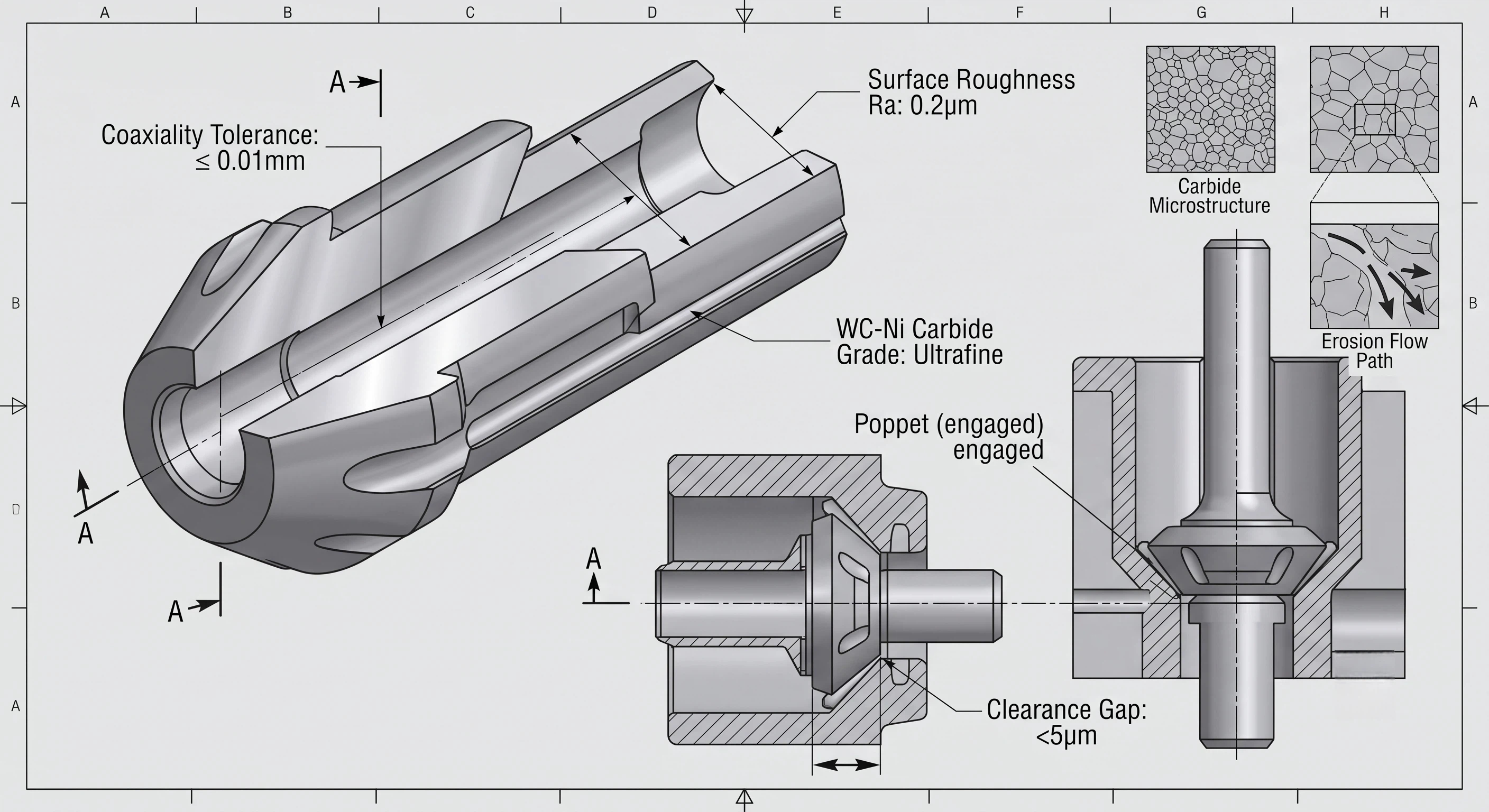
Thousands of meters deep, the pulser must withstand multiple physical extremes:
Dual-Pressure Dynamics: Hydrostatic pressure at the bottom of the well typically exceeds 100 MPa to 140 MPa. Simultaneously, dynamic pressure from mud pumps and rapid pressure surges during pulsation require components with exceptionally high fatigue strength.
High-Velocity Mud Erosion: Drilling mud, weighted with materials like quartz sand and barite, flows past pulser internals at extreme velocities. Any minute structural discontinuity or material weakness can be carved into deep grooves in a short time, leading to signal distortion or tool failure.
High-Frequency Vibration: Multi-directional vibrations from rock crushing at the drill bit can easily lead to threaded connection loosening or interference and seizing of precision mating surfaces.
To achieve precise valve "opening and closing" under high pressure and intense erosion, several core internal components demand ultimate tolerances in size and geometric form:
In rotational pulsers, the relative position of the rotor and stator determines the flow cross-section, generating pressure pulses.
Precision Requirement: The axial and radial mating clearances between the rotor and stator typically must be controlled to the micron level.
Failure Risk: Excessive clearance leads to signal leakage and reduced pulse amplitude, preventing clear decoding at the surface. Insufficient clearance can cause immediate seizing due to thermal expansion at high temperatures or debris ingress.
In poppet-style (or lift valve) pulsers, pressure waves are created by the high-frequency insertion and retraction of the poppet into the orifice.
Precision Requirement: The contact surfaces are usually designed as precision tapered fits. The coaxiality requirement is typically $\le 0.01 \text{ mm}$, and surface roughness ($Ra$) must reach $0.2 \ \mu\text{m}$ or better.
Failure Risk: Even micro-eccentricity can trigger localized, high-velocity vortexes on one side, leading to cavitation and uneven wear. This can completely destroy the valve port within dozens of hours.
These guide and limit mud flow to protect sensitive internal components. The roundness of the internal bore and the smoothness of the flow path transitions directly impact fluid dynamics. They demand surfaces entirely free of micro-burrs or machining marks.
Even a perfect structural design remains a "paper blueprint" under high-pressure erosion without top-tier material support. Tungsten Carbide has become the absolute material of choice for core MWD pulser wear parts due to its unparalleled hardness, compressive strength, and excellent wear and corrosion resistance.
For MWD component precision manufacturing, tungsten carbide application meets even stricter standards:
Microstructure Uniformity: Ultrafine grain tungsten carbide must be used to ensure the material is non-porous and free of loose carbon. This prevents micro-cracking under alternating high-pressure stress.
Optimized Binder Phase: For corrosive drilling fluids, specialized Nickel-Chrome (Ni-Cr) or Cobalt-Nickel (Co-Ni) binders are employed to significantly extend component corrosion-fatigue life in acidic, alkaline, and briny environments.
Producing MWD pulser components suitable for high-pressure environments involves an extremely complex manufacturing chain:
Ultra-Precision Grinding and Polishing: Due to the extreme hardness of tungsten carbide, high-precision CNC grinding with diamond wheels is mandatory, followed by multiple stages of manual or mechanical mirror polishing to eliminate residual machining stress.
Precision Wire EDM and Sinker EDM: For complex internal flow paths and custom, non-standard geometries, high-precision Electrical Discharge Machining is utilized to ensure micron-level profile accuracy.
CMM and Pneumatic Gauging: Every finished valve seat, poppet, and rotor must undergo geometric tolerance inspection via Coordinate Measuring Machines (CMM) and pass air-tightness or high-pressure pressure testing to ensure zero leakage under simulated downhole high-pressure conditions.
As oil and gas drilling pushes further into deepwater, ultra-deep terrestrial, and unconventional frontiers, every stable "beat" of an MWD pulser relies on micron-level precision and synergy between steel and tungsten carbide internals.
As a specialist manufacturer focused on custom, high-precision, high-wear industrial components, we understand the exacting demands that high-pressure environments place on every dimensional tolerance. By utilizing top-tier tungsten carbide grades, coupled with rigorous precision machining and quality control, we are committed to providing global clients with stable, durable, and high-precision MWD core components, ensuring every deep-well operation reaches its target safely and efficiently.
For more information on MWD valve seats, poppets, and custom tungsten carbide wear solutions, please contact our expert technical team.

